Off-chain intelligence
The blockchain is half the evidence. Glacier21 is the other half.
A public ledger records every hop and never records who. The person behind a wallet shows up somewhere else: in a breached email, a reused handle, a page on the general web, a name written in another language. Glacier21 connects those traces to the wallets they point to, so an investigation can end with a person instead of an address.
- Blockchains
- 35+
- Labeled wallets
- 500M+
- Off-chain tags
- 1.9B+
- Unique sources
- 580K+
Blockchains
Labeled wallets
Off-chain tags
Unique sources
Definition
What is off-chain intelligence?
Everything about a wallet that is not written on the blockchain. The chain is permanent, public and impossible to edit, which makes it the most honest witness in any case. It is also silent on the one question every case comes down to: who holds the keys.
What the ledger tells you
- Every transfer, amount and timestamp
- Which wallets paid which
- Where funds entered a mixer, bridge or exchange
- Balances still sitting in a wallet
What Glacier21 adds
- The email and phone number behind an account
- The handle that posted or claimed the wallet
- The web page that listed it next to a name
- The legal name, in the language it was written in
One search, both sides
Search the person, not only the wallet.
Type an email, a phone number or a handle into a chain-only tool and you get nothing, because none of them are on any blockchain. Type them into Glacier21 and you get the breach records, usernames, web pages and names around them, and the wallets they lead to.
Kinds of off-chain evidence
Some of the places the person behind a wallet shows up.
None of these are on the blockchain, so none of them appear in a tool that only reads the blockchain. Glacier21 searches all of them and ties each finding back to a wallet.
The email in the leak
The handle people forget
The page the internet kept
The name in another language
The ID next to the address
Sanctions, exploits and enforcement
Off-chain in action
From a wallet to a person, one hop at a time.
A case can start on either side of the chain. Watch each one cross from on-chain to off-chain and back, the way it does in Glacier21.
- WALLETON-CHAIN
- AUTO-TRACEON-CHAIN
- WEB FOOTPRINTOFF-CHAIN
- USERNAMEOFF-CHAIN
- BREACH RECORDOFF-CHAIN
- IDENTITYOFF-CHAIN
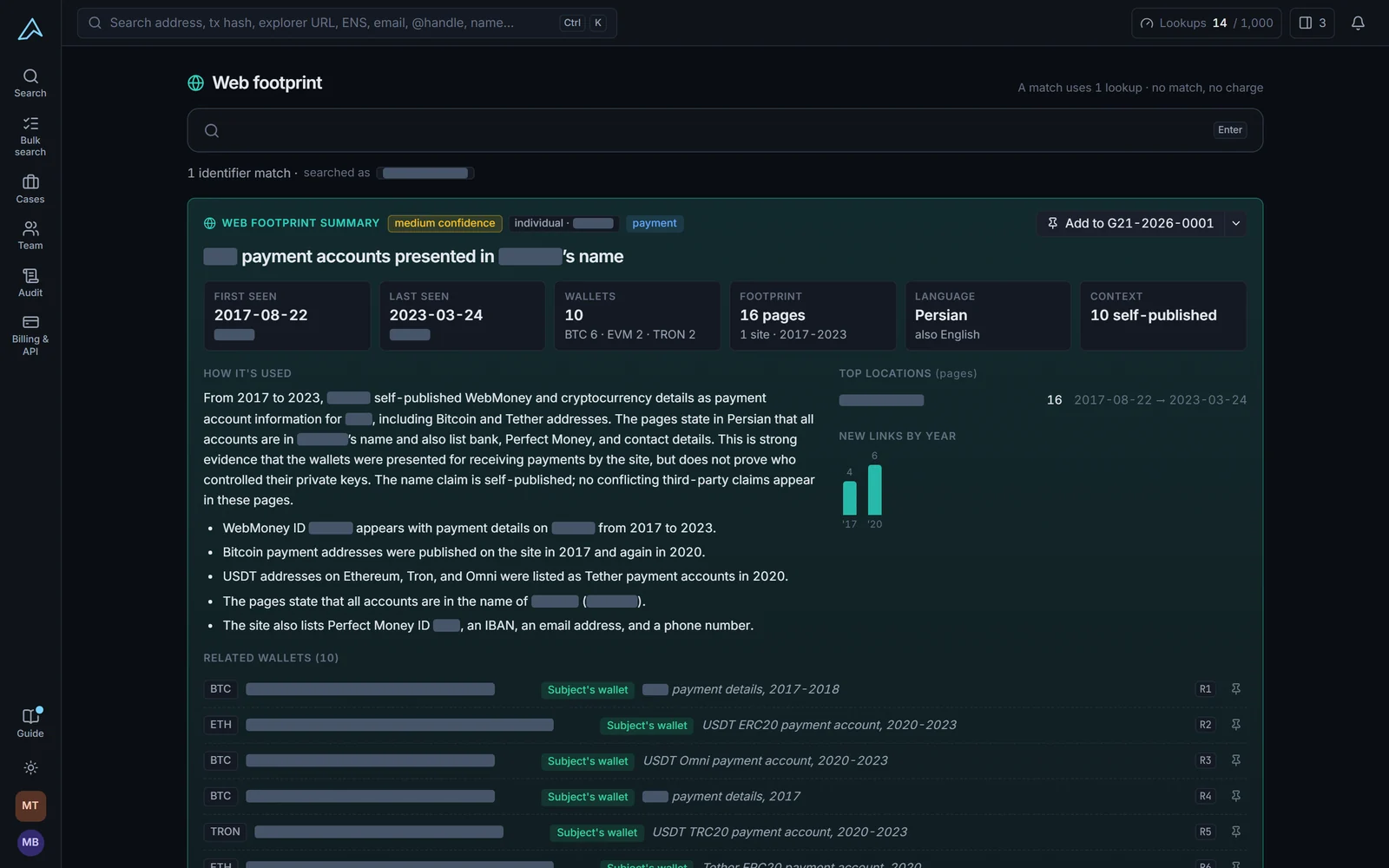
Web footprint
People were careless in 2017. The internet kept the receipts.
Glacier21 searches the general web for an email, handle or payment ID and shows what was published next to it. Here a single WebMoney ID leads to a payment site that listed ten crypto wallets in one person's name, for six years.
- Web pages with first and last seen dates
- Wallets published next to the identifier
- A written summary with a confidence level
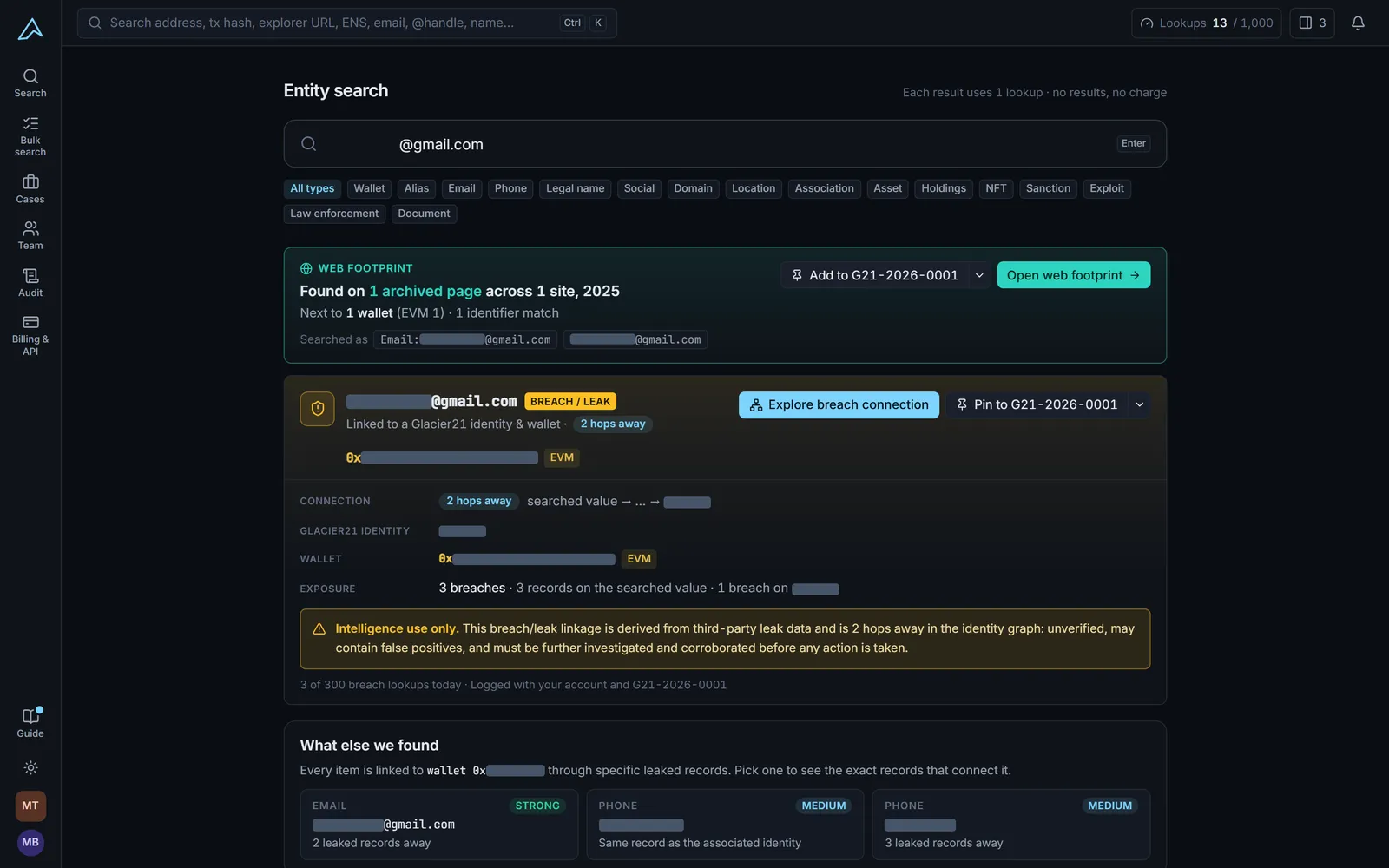
Breach and leak intelligence
An email search that ends at a wallet.
For teams granted access, one email search shows the web page it appeared on and the leaked records that connect it, two hops away, to an identity holding a wallet. Each related email and phone is graded by how strongly it connects.
- Hops between the search and the wallet
- Strong and medium connections marked
- Logged with your account and case
Built to be relied on
Off-chain findings you can defend.
Off-chain evidence is only useful if you can explain where it came from and how strong it is. Glacier21 shows both on every connection.
Every label shows where it came from
Strength on every connection
Leads, not verdicts
Sensitive data, controlled
FAQ
Questions about off-chain intelligence.
What is off-chain intelligence?
Off-chain intelligence is everything about a crypto wallet that is not written on the blockchain: the emails, phone numbers, usernames, names, web pages and records that connect a wallet to the person or company that operates it. The blockchain shows where money moved. Off-chain intelligence shows who moved it.
What is the difference between on-chain and off-chain analysis?
On-chain analysis reads the public ledger: transfers, counterparties, balances and flows through mixers, bridges and exchanges. Off-chain analysis looks outside the ledger for the identity behind those flows. Most investigations need both: on-chain to follow the money, off-chain to name the operator.
Can you find out who owns a crypto wallet?
Often, yes. Glacier21 shows any attribution it holds for a wallet, with the source behind it, and connects the wallet to off-chain traces such as handles that posted it, web pages that listed it and, for teams with access, breach records. Treat each finding as a lead to corroborate.
Can I start from an email, a phone number or a username?
Yes. One search box takes wallets, transaction hashes, emails, phone numbers, @handles, names in any language, payment IDs and domains, and returns the wallets and records connected to what you typed. A chain-only tool returns nothing for an email, because an email is not on any blockchain.
How much off-chain data does Glacier21 have?
More than 1.9 billion off-chain tags from more than 580,000 unique sources, connected to more than 500 million labeled wallets across 35+ blockchains.
How is sensitive data like breach records controlled?
Breach intelligence is restricted. Glacier21 enables it for an organization and for each member separately, only seat holders on paid plans can use it, every user accepts an intelligence-use notice first, there is a daily lookup cap, and every lookup is logged with the user and the case.
See what your cases are missing off-chain.
Get a live walkthrough of Glacier21 on real data: identity search, web footprint, breach intelligence and auto-trace, from a wallet to a person.
Keep reading