For law firms and litigation teams
Find the crypto. Name the exchange. Serve the right subpoena.
For litigators, asset recovery and judgment enforcement counsel. Glacier21 traces crypto to the exchange that can identify the account holder, connects wallets to the people behind them, and delivers findings written for a declaration, not a dashboard. Built by former federal prosecutors and FBI agents.
- Blockchains
- 35+
- Labeled wallets
- 500M+
- Off-chain tags
- 1.9B+
- Unique sources
- 580K+
Blockchains
Labeled wallets
Off-chain tags
Unique sources
Where crypto shows up
It is already in your matters. It just is not in the documents.
Crypto has no bank statement, no title and often no account in a name you would recognize. These are the matters where it hides most.
Investment and fraud disputes
Judgment enforcement
Bankruptcy and receiverships
Divorce and disclosure
Partners, founders and employees
Internal investigations
How it works
From a lead in the file to a subpoena that lands.
The chain shows where the money went. The off-chain record shows who controls it. Discovery needs both.
- 01
Start from the file
A wallet, a transaction, an email, a phone number, a handle, a name in any language, or a screenshot the other side produced.
- 02
Trace to the cash-out
Auto-trace follows the funds across chains and bridges until they reach an exchange, a service or a wallet still holding them.
- 03
Put a person on it
Off-chain intelligence connects the wallets to the profiles, pages and records of the person who controls them.
- 04
Serve the right target
A target list for discovery: the exchange, the deposit address, the transactions and the dates, with the sources behind each.
Trace
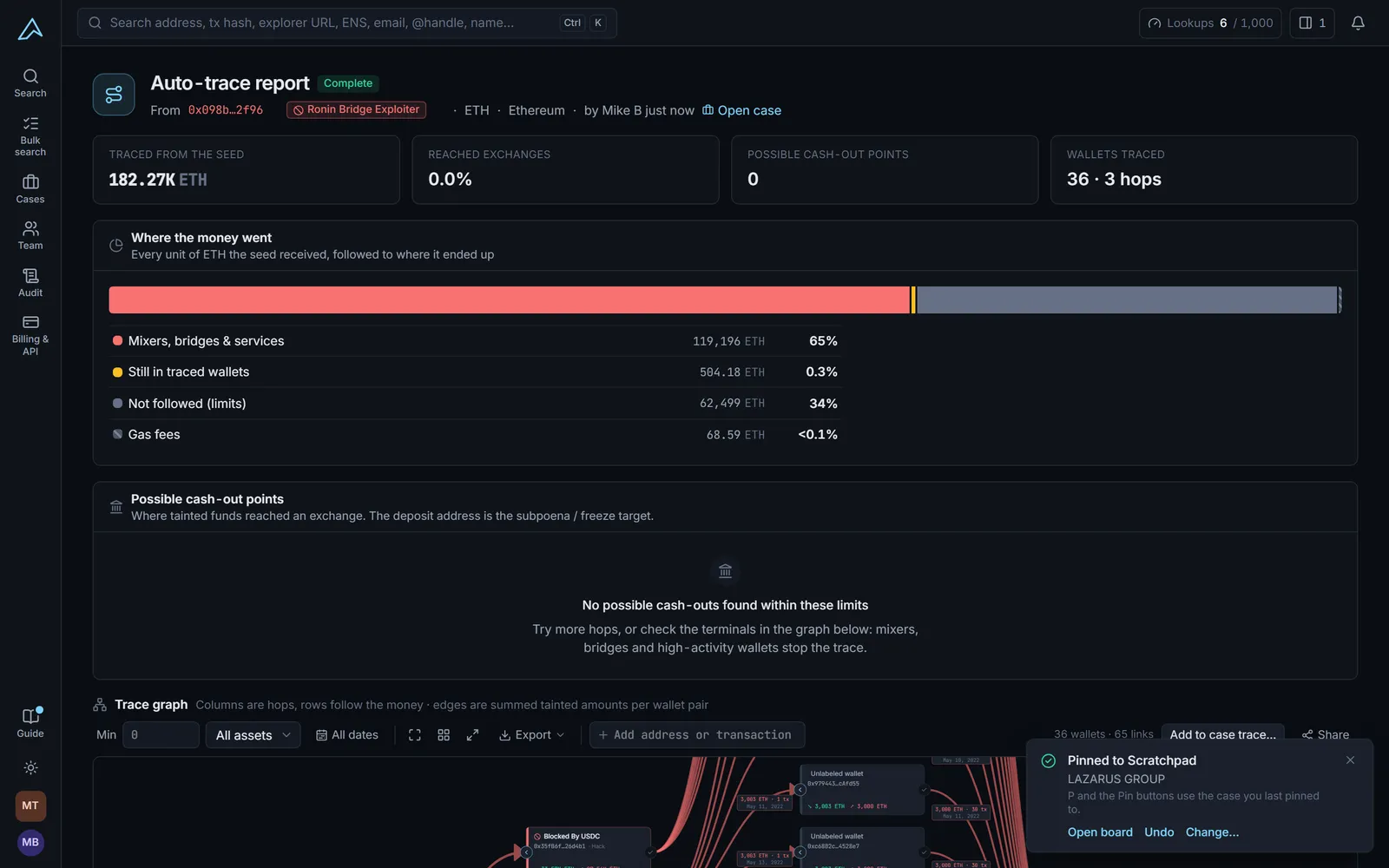
Know which exchange to subpoena before you draft it.
Auto-trace follows funds hop by hop and books every unit: to exchanges, to services, to wallets still holding it, and to the paths it stopped on and why. Each cash-out names the exchange it reached, so the subpoena goes to the company that can actually identify the account holder. How auto-trace works →
- The exchange and deposit address for each cash-out
- FIFO or haircut, saved with the trace
- A time window around the dates in dispute
Identify
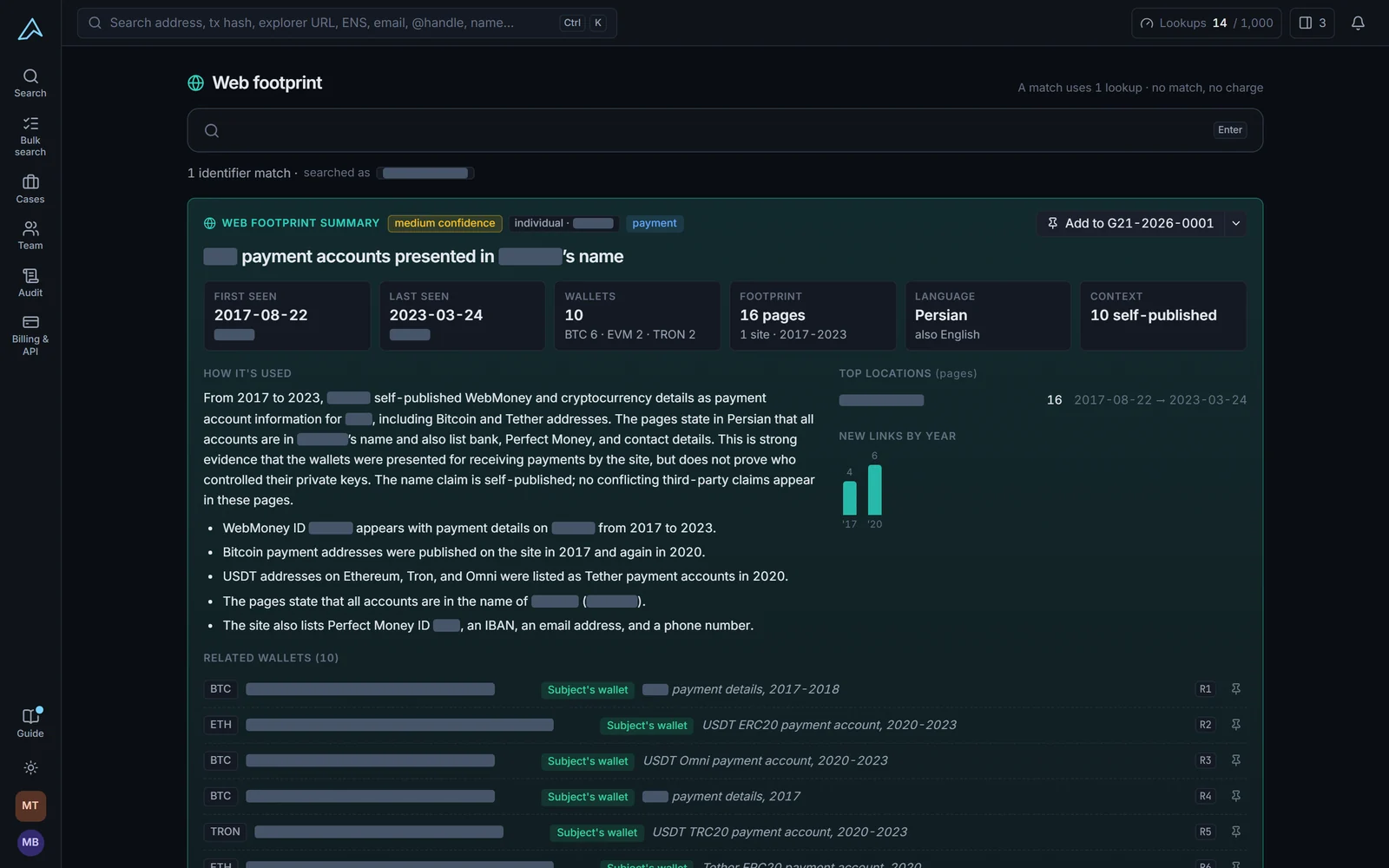
Connect the wallet to the person, with the page that proves it.
The person behind a wallet is almost never on the chain. Glacier21 searches the general web, usernames, names in any language and, where granted, breach records, and shows the source for every link it makes. How off-chain intelligence works →
- Start from an email, phone, handle or name
- Web pages with first and last seen dates
- Sanctions and law-enforcement flags up front
Documents that do not add up
When the other side produces crypto evidence, we test it.
The most common answers in a crypto dispute are a screenshot, a spreadsheet and a story. Each one can be checked against the chain.
A balance screenshot instead of a statement
Exchange reports that do not reconcile
A claim that it was hacked or lost
It is in a wallet nobody can reach
What counsel gets
Discovery targets, not a dashboard.
Every engagement ends with something you can file, serve or put in front of a witness.
- The exchanges to subpoena, by name, with the deposit addresses that reached them
- Transaction hashes, amounts and timestamps for each step of the trail
- The wallets and accounts tied to the person, and the records that tie them
- A timeline built around the dates in dispute
- Plain-English declarations, expert reports and testimony from our team
Built for the record
Findings that hold up when they are challenged.
Opposing counsel will ask how you know. The answer is in the case file.
Every conclusion cited
Hashed snapshots
Traces the other side can rerun
Written for the record
White glove
Former federal prosecutors and FBI agents, on your matter.
Our in-house team has run Rule 2004 examinations, Chapter 15 liquidations and cross-border tracing, and referred fraud to federal authorities on behalf of victims. When a matter needs more hands, they take it on: tracing, attribution, expert reports and testimony.
FAQ
Questions law firms ask us.
Can Glacier21 tell us which crypto exchange to subpoena?
Yes. Auto-trace follows the funds until they reach a wallet or deposit address that Glacier21 labels as belonging to an exchange, and names the exchange. That is the company that holds the account holder's identity records.
What do we need to start?
Whatever is in the file. A wallet address or transaction is ideal, but an email, a phone number, a username or a name, in any language, is often enough to find the wallets connected to a person.
Will the findings hold up if they are challenged?
Every attribution is sourced, pinned evidence is saved as a hashed snapshot, and traces are reproducible from their saved settings. Our team prepares expert reports and can testify to the work.
Can our client and co-counsel see the case?
Yes. Viewers and case guests are free. They read the case and comment without editing, and guests only see the cases they are invited to.
Can you trace funds that moved offshore?
Crypto crosses borders without a bank, so the trace does too. We show which foreign exchange or service the funds reached, so counsel can decide whether the fight is worth having and where to have it.
How is an engagement scoped?
Most firms start with a preliminary assessment: what the chain and the off-chain record show, and whether a full engagement is warranted. Firms with in-house investigators can also take seats on the platform directly.
If you think the crypto is there, it probably is.
Start with a preliminary assessment of what the chain and the off-chain record show, and whether a full engagement is warranted.
Keep reading