Auto-trace
Money has to stop somewhere. Auto-trace finds where.
Stolen crypto is only useful to a thief once it becomes something else, and that usually happens at an exchange. Glacier21 auto-trace follows the funds hop by hop, across chains and bridges, accounts for every unit, and names the exchanges where it landed, the place a subpoena or a freeze request goes.
- Blockchains
- 35+
- Labeled wallets
- 500M+
- Off-chain tags
- 1.9B+
- Unique sources
- 580K+
Blockchains
Labeled wallets
Off-chain tags
Unique sources
The report
Every unit, accounted for.
A trace that loses money along the way is a trace you cannot put in front of a judge. Auto-trace books every unit of the seed into a bucket, so what went in always equals what the report shows, down to the smallest unit. Here 182,270 ETH from the Ronin Bridge exploit, followed to the mixers, bridges and services it reached.
- Exact accounting, no rounding
- Every stop named, every limit stated
- Exchanges named on every cash-out
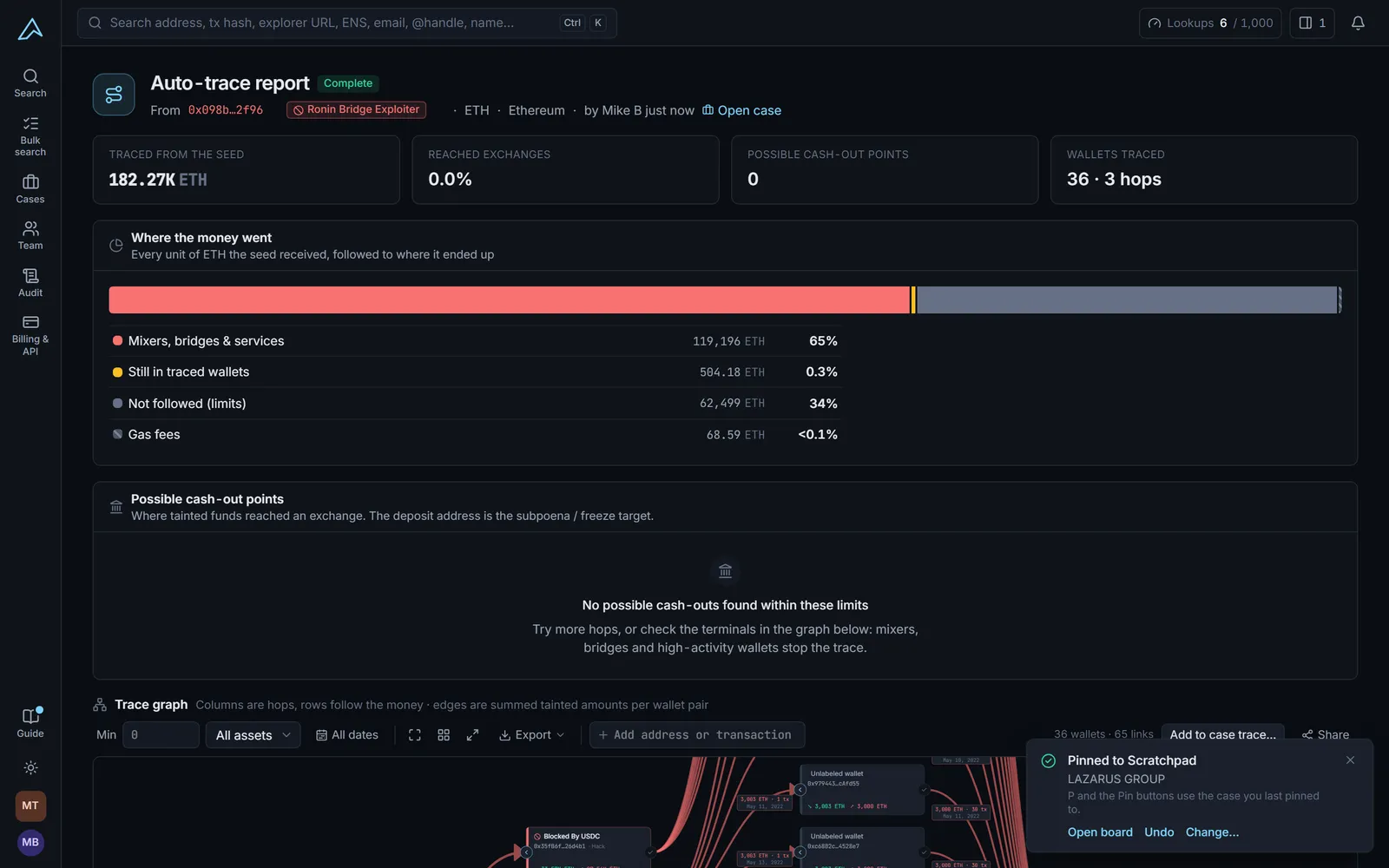
Where the money went
Five buckets. Nothing falls through.
Every trace ends with the full amount split into five buckets, each one broken down by the wallet or service that holds it.
Exchanges
Funds that reached an exchange or an exchange deposit address. This is where cases usually turn into a subpoena or a freeze request.
Services
Mixers, bridges, DEXes and gambling sites, each named, with the amount that went into each one.
Still in traced wallets
Funds sitting in wallets the trace reached. The ones worth watching, or seizing.
Not followed
Funds the trace deliberately stopped on, and why: a fan-out cut, the hop limit, the node budget or the time window.
Pending
Funds on paths the trace has not finished resolving yet.
The cash-out
Where the money met an exchange.
Glacier21's labels cover exchange wallets and the deposit addresses exchanges assign to their customers. When traced funds reach one, auto-trace stops there, names the exchange and keeps the path that led to it. A deposit address belongs to one customer account, which is exactly what a preservation request or subpoena needs.
- Exchange and deposit-address labels, each with its source
- The exchange named on every cash-out
- The path from the seed, hop by hop
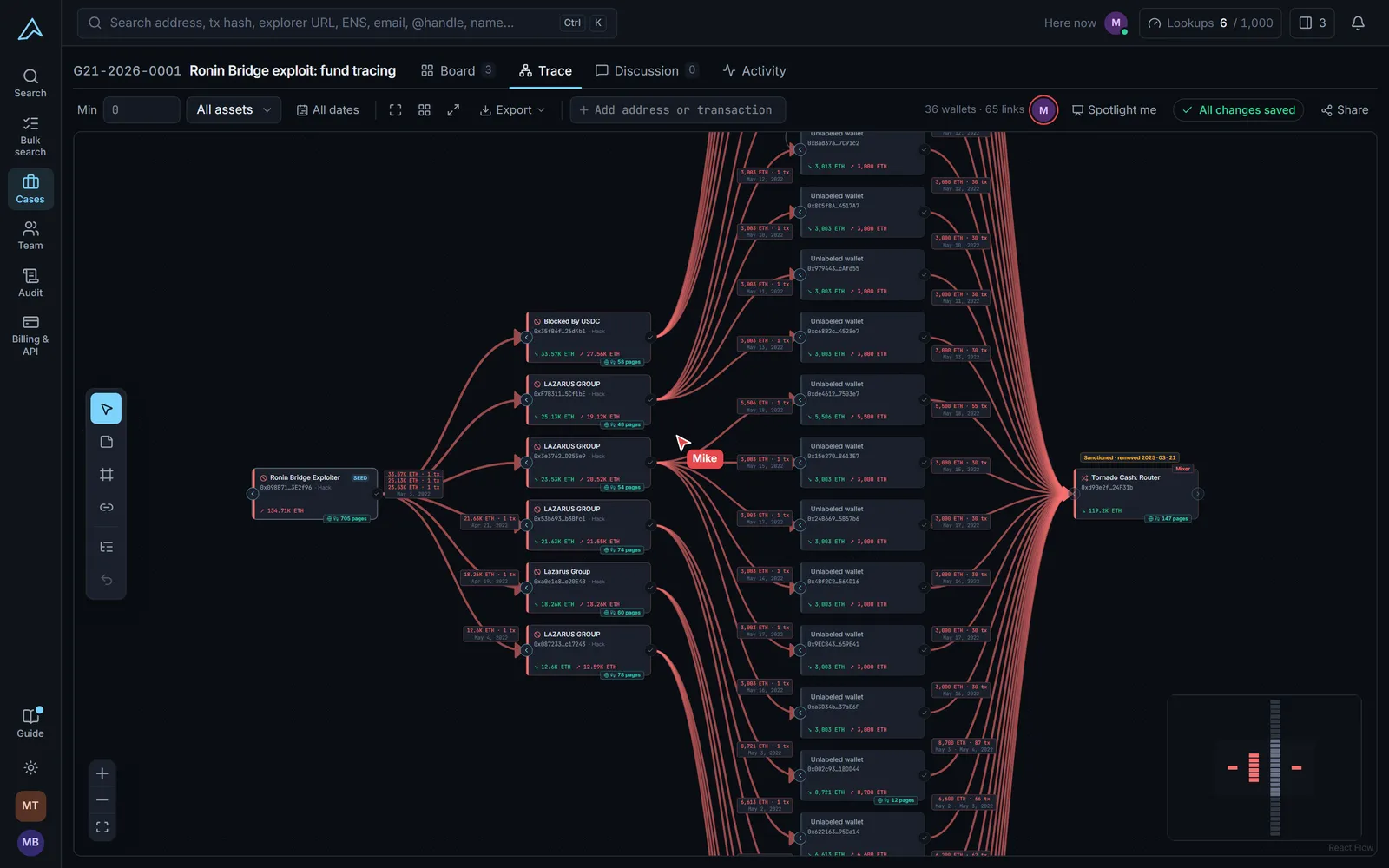
Settings
Trace the way your case needs, and say so in the report.
Every setting is saved with the trace, so anyone reading the result knows exactly how it was produced.
FIFO or haircut
Start where the theft started
Ignore the dust
Follow the big money first
Bound the search
Stay inside the timeline
Where traces stop
Ten kinds of stop, each one named.
A trace stops when funds reach a place where following further would mislead, such as a pooled exchange wallet or a mixer. You see which kind of stop it was, and how much reached it.
- Exchange
- Exchange deposit
- Mixer
- Bridge
- DEX
- Gambling
- Service
- Hack
- Scam
- Sanctioned
Coverage
Across chains, through bridges, exact on Bitcoin.
Thieves hop chains to break the trail. Auto-trace follows them across 28 bridge protocols and through Bitcoin, Ethereum and EVM chains, Tron, Solana, XRP Ledger and NEAR. On Bitcoin it traces exact UTXOs, not estimates.
Built for the record
A trace you can defend months later.
The hardest question in a crypto case is usually asked by a defense attorney: how do you know? Auto-trace is built so the answer is the trace itself.
Same inputs, same answer
Every unit accounted for
Why it stopped, on every path
Saved into the case
FAQ
Questions about auto-trace.
How do you trace stolen cryptocurrency?
Start from the theft transaction or the first receiving wallet. Auto-trace follows the funds hop by hop, across chains and bridges, and stops where they reach an exchange, a mixer, a bridge or another service. The exchange deposit address at the end is what you send a preservation request or subpoena to.
What is the difference between FIFO and haircut tracing?
FIFO (first in, first out) treats the first funds into a wallet as the first funds out, and is the method courts usually expect. Haircut spreads stolen funds pro-rata across everything leaving a wallet, which suits wallets that mix stolen and clean money. Glacier21 runs either.
Can auto-trace follow funds across chains?
Yes. Auto-trace follows funds across 28 bridge protocols and covers Bitcoin, Ethereum and EVM chains, Tron, Solana, XRP Ledger and NEAR, with exact UTXO tracing on Bitcoin.
How does auto-trace know it reached an exchange?
From Glacier21's labels. Glacier21 labels exchange wallets and the deposit addresses exchanges assign to their customers. When traced funds reach one, the trace stops there, names the exchange and shows the path from the seed. The exchange behind a deposit address can identify the account holder.
Can opposing counsel reproduce the trace?
Yes. The engine is deterministic: the same seed and settings produce the same result and the same result hash. The settings are saved with the trace.
What happens to funds the trace does not follow?
They are still counted. Funds below your minimum, beyond the fan-out cap, past the hop limit or outside the time window are booked in their own bucket with the reason, so the totals always add up.
See where the money stopped.
Get a live walkthrough of auto-trace on real data, from the theft transaction to the exchange deposit address, with every unit accounted for.
Keep reading